


Key Takeaways
- Crypto wallets are pseudonymous, not anonymous. An address has no name attached, but it carries a complete, permanent public history that can be linked to a real person under the right conditions.
- Identity usually gets attached at the edges, not on-chain. The moment funds touch a regulated exchange, a KYC record exists, and a legal request can connect that record to the address.
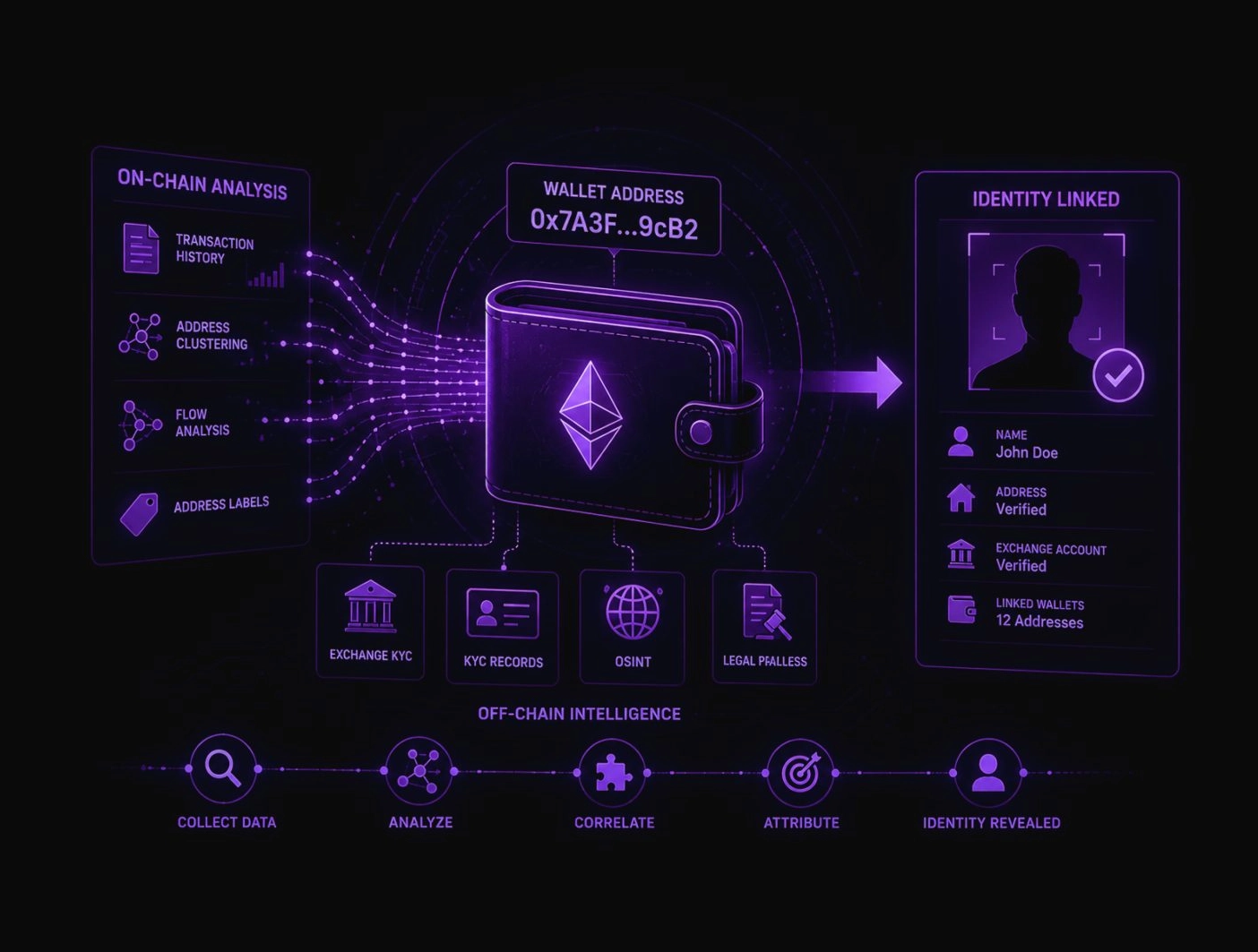
- Investigators combine on-chain analysis with off-chain intelligence. Clustering, behavioral patterns, address labeling, and open-source research together narrow an address down to an entity, and sometimes a name.
- A curious individual can see everything an address did, but not who controls it. Genuine attribution almost always requires data held by exchanges or accessible only through legal process.
- The most famous cases prove the point. The Bitfinex hack and the first sanctioned Bitcoin addresses both ended with named people, years after the transactions, because the trail never disappeared.
- Match Systems runs OSINT and on-chain investigations to attribute wallets, trace stolen funds, and support law enforcement and legal recovery.
In This Article
- Pseudonymous, Not Anonymous
- What a Wallet Address Actually Reveals
- How Identity Gets Attached to an Address
- What This Looks Like in Practice
- Can a Regular Person Identify a Wallet Owner?
- Where Attribution Hits Its Limits
- How Match Systems Approaches Attribution
- FAQ
Pseudonymous, Not Anonymous
The belief that a crypto wallet is anonymous is one of the most expensive misconceptions in the space. It reassures criminals who think a string of characters protects them, and it discourages victims who assume there’s nothing to find. Both are wrong, and the gap between what people assume and what’s actually possible is where most of our investigative work happens.
A wallet address reveals nothing about identity on its face. There’s no name, no email, no passport number written into the blockchain. What there is, instead, is a complete and permanent record of everything that address has ever done. That history is the thread investigators pull.
What a Wallet Address Actually Reveals
Open any blockchain explorer and paste in an address: you’ll see every transaction it has ever made or received, the amounts, the timestamps, the counterparties, and the current balance. None of that is privileged. It’s public by design, visible to anyone, forever.
What you won’t see is a name. This is the distinction between pseudonymity and anonymity, and it matters enormously. An anonymous system would leave no trace. A pseudonymous one leaves a complete trace attached to a pseudonym, the address, and the entire question of attribution comes down to connecting that pseudonym to a person.
Back in 2013, researcher Sarah Meiklejohn at UC San Diego demonstrated how fragile that pseudonym really is. By making a series of ordinary transactions and tracing them through the Bitcoin blockchain, she showed that supposed anonymity collapsed under straightforward analysis. The methods available today are far more powerful than what she used.
How Identity Gets Attached to an Address
There’s no single technique that unmasks a wallet. Attribution is the product of several methods layered together, each narrowing the field until an address resolves to an entity.
- Exchange KYC and legal process. This is the most direct path. Regulated exchanges are required to verify customer identity, so any deposit or withdrawal that touches a compliant exchange creates a record tying an address to a verified person. Investigators can’t read that record directly, but a subpoena, court order, or law enforcement request can compel the exchange to produce it. Most attributions ultimately rest on this single fact: almost everyone cashes out somewhere regulated eventually.
- Address clustering. Multiple addresses controlled by the same person tend to behave in revealing ways. When several addresses are spent together as inputs to one transaction, they almost certainly share an owner, because each input has to be signed with its own key. Clustering techniques fold large numbers of addresses into a single entity profile, so identifying one address in a cluster can expose dozens more.
- Behavioral and timing analysis. People are creatures of habit, even on-chain. Transaction timing that follows a particular time zone, repeated interaction with the same services, characteristic amounts, and consistent gas settings all form a fingerprint. Over enough activity, that fingerprint starts to distinguish one user from the crowd.
- Address labeling. Investigators and analytics teams maintain databases that tag known addresses: this cluster is an exchange, that one a darknet market, this one a sanctioned entity. When traced funds touch a labeled address, the context propagates across the connected graph, and the picture of who’s involved sharpens. The depth of a labeling database is one of the things that most affects how quickly an investigation moves.
- Open-source intelligence. People reveal their own addresses constantly. A donation address posted on social media, an ENS name tied to a public profile, a wallet pasted into a forum thread or a GitHub repository, a screenshot with an address visible. Cross-referencing these public signals against on-chain activity is often what turns a cluster into a name, and it’s the layer where a careful investigator earns their result.
Attribution Methods at a Glance
|
Method |
What it reveals |
What it requires |
|
Exchange KYC |
A verified real-world identity behind an address |
A subpoena, court order, or law enforcement request |
|
Address clustering |
Other addresses controlled by the same owner |
On-chain analysis of co-spending and change patterns |
|
Behavioral analysis |
Timing, habits, and a usage fingerprint |
Enough transaction history to find patterns |
|
Address labeling |
Whether funds touched known entities |
A maintained, high-quality labeling database |
|
OSINT |
Self-disclosed links between address and person |
Open-source research across the public web |
What This Looks Like in Practice
The theory is easier to trust when you see it produce names.
The Bitfinex hack is the clearest example. In 2016, roughly 120,000 bitcoin were stolen from the exchange and moved into a wallet controlled by the thief. For years, most of it sat untouched. Then it began to move, and the trail led investigators to a married couple in New York. In November 2024, Ilya Lichtenstein was sentenced to five years for the hack, and the US Department of Justice confirmed it had seized more than 94,000 bitcoin, the largest financial seizure in its history at the time. The blockchain remembered everything, and the years that passed didn’t erase a single hop.
The first sanctioned Bitcoin addresses tell a similar story from the regulatory side. In November 2018, the US Treasury’s OFAC named two Iranian men, Ali Khorashadizadeh and Mohammad Ghorbaniyan, and publicly attached their Bitcoin addresses to their identities — the first time the agency had ever done so. The addresses had processed thousands of transactions tied to the SamSam ransomware scheme. Once published, those addresses became radioactive across the regulated financial system.
Can a Regular Person Identify a Wallet Owner?
This is where expectations need adjusting. A curious person with a block explorer can learn an enormous amount: the full transaction history, the counterparties, the cluster an address probably belongs to, and any public labels attached to it. What they almost never can do is take the final step to a verified real-world identity.
That last step usually depends on data held privately by exchanges, and exchanges don’t release customer information to members of the public. They release it in response to a subpoena, a court order, or a law enforcement request supported by a legitimate investigation. This is the wall most amateur efforts hit. You can follow the money to the doorstep of an exchange, but you can’t open the door yourself.
It’s also why amateur sleuthing, while occasionally useful for generating leads, rarely produces actionable attribution on its own. The value comes from pairing on-chain tracing with the legal mechanisms and exchange relationships that turn a probable cluster into an accountable person. That combination is what professional investigators like Match Systems and law enforcement bring.
Where Attribution Hits Its Limits
Attribution is powerful, but it isn’t automatic, and honesty about its limits matters.
Some addresses never touch a regulated exchange, which removes the most reliable identity anchor. Funds routed only through decentralized infrastructure and self-custody can stay pseudonymous far longer. Mixing services and freshly generated wallets add layers of separation, though they leave behavioral patterns of their own. Privacy-focused technologies present genuine technical and regulatory challenges to on-chain analysis. And when funds or suspects sit in jurisdictions that won’t cooperate with legal requests, the on-chain trail can be perfectly clear while the path to a name stays blocked.
None of this makes a wallet anonymous. It makes attribution harder, slower, and more dependent on getting the right intelligence at the right moment, which is exactly why the speed and quality of an investigation matter so much.
How Match Systems Approaches Attribution
When Match Systems works an attribution case, the on-chain tracing and the off-chain intelligence run together. We map the address clusters and follow the funds, then layer in OSINT and our proprietary labeling database to identify the entities behind the activity, and we coordinate with exchanges and law enforcement where a verified identity or a freeze requires legal process. It’s the same approach behind investigations into cases like Atomic Wallet and CoinsPaid: the blockchain provides the trail, and disciplined investigation turns the trail into an answer.
FAQ
Can you find out who owns a crypto wallet from the address alone?
Not from the address by itself. The address shows you a full transaction history and the cluster it likely belongs to, but the name behind it has to come from somewhere else, usually a regulated exchange’s KYC records or an open-source disclosure the owner made themselves. The address is the starting point, not the answer.
Are crypto transactions anonymous?
No. They’re pseudonymous. Every transaction is permanently public and tied to an address rather than a name. Because the record never disappears, an address that looks anonymous today can be attributed years later once the right piece of identifying information surfaces, exactly as happened in the Bitfinex case.
Can I get an exchange to tell me who owns an address?
Not as a private individual. Exchanges release customer identity only in response to a subpoena, court order, or law enforcement request connected to a legitimate investigation. This is why serious attribution cases run through investigators and authorities rather than through a member of the public asking directly.
Does using a mixer make a wallet impossible to identify?
It makes the trail harder to follow, not impossible. Mixing services add layers of separation, but funds entering and leaving them leave behavioral and timing patterns that investigators read. Most large mixers have also faced sanctions or shutdowns, which limits how useful they are for moving significant amounts.
How do investigators connect a wallet to a real person?
By layering methods. They cluster the addresses an owner controls, analyze behavioral patterns, check the funds against labeled databases, and run open-source research for self-disclosed links, then use legal processes to obtain KYC data where the funds touched a regulated exchange. Match Systems combines these on-chain and off-chain techniques and coordinates with exchanges and law enforcement to reach a verified identity.
When a wallet is connected to theft or fraud, the trail is only useful if someone follows it before it goes cold.
Every hop is recorded, but turning that record into a name and a recovery takes on-chain tracing, open-source intelligence, and the legal relationships to act on what’s found. Match Systems investigates wallet attribution and crypto theft, working with exchanges and law enforcement to identify the people behind an address and support legal recovery, drawing on a proprietary labeling database built over years of active cases.
Start a case assessment: https://matchsystems.com

Hot Stories
- News Fake Meeting Link Scam: How Crypto Gets Stolen
- News HTX Sanctions: Risks for Crypto Assets
- Articles How hackers steal cryptocurrency
- News Tether Unfroze $79M - And We Know Why
- News Crypto Asset Recovery Through OTC Networks
- Articles Tether Froze Your USDT: What’s Happening and What to Do
- Articles Crypto Theft Schemes 2026: Analysis & Protection
- Articles Crypto Stolen: A Step-by-Step Action Plan
- Articles I Clicked a Link and Lost My Crypto — What Happened?
- Articles How Blockchain Tracking Works (And Why Crypto Is Traceable)