


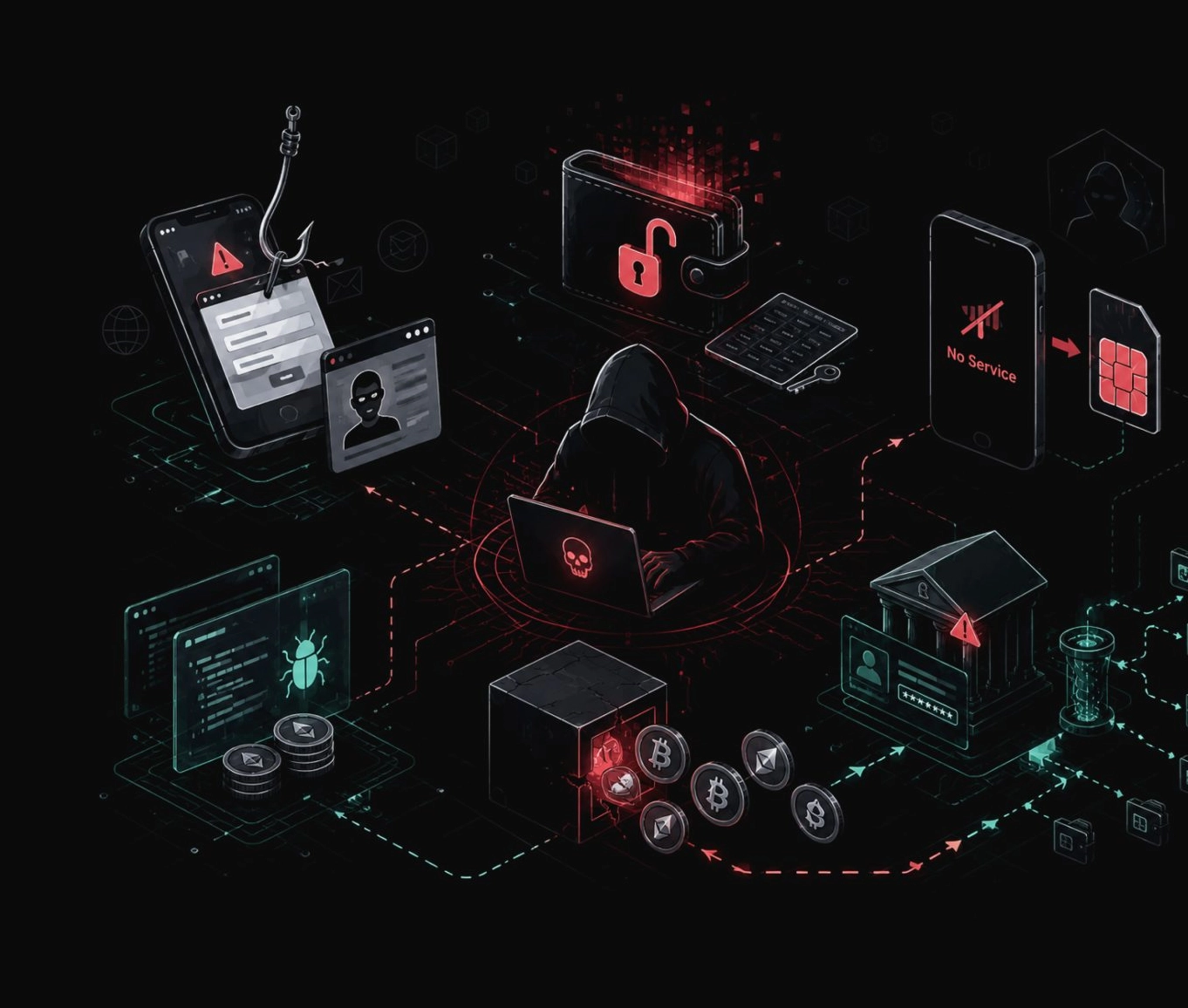
Key Takeaways
- The blockchain itself has never been hacked. Almost all crypto theft happens through the people and systems around it: wallets, interfaces, exchanges, and human error.
- Hackers don’t need to break encryption. They just need your private key or seed phrase, and there are many ways to get it without touching any code.
- Phishing is the most common attack method by far. Fake websites, malicious transaction approvals, and AI-generated impersonation now account for a massive share of individual losses.
- SIM swapping lets attackers hijack your phone number and bypass two-factor authentication.
- Smart contract bugs and exchange hacks tend to make headlines, but the majority of 2025 losses came from compromised private keys and social engineering, not code exploits.
- If your funds are stolen, the first 48 hours are the window that matters most. Firms like Match Systems can trace stolen funds across chains and work directly with exchanges to freeze assets, but only if the process starts early enough.
In This Article
- Why Crypto Gets Stolen — The Real Reason
- Phishing and Social
- Engineering
- Private Key and Seed
- Phrase Theft
- SIM Swapping
- Smart Contract Exploits
- Exchange and Custodian Hacks
- What to Do If You’ve Been Targeted
- FAQ
Why Crypto Gets Stolen — The Real Reason
There’s a persistent assumption that crypto theft is a cryptography problem: that somewhere, a mathematician cracked an algorithm or found a flaw in the blockchain’s design. That assumption is wrong, and it matters, because it leads people to misplace their defenses.
Blockchain code doesn’t get hacked. Private keys, seed phrases, and humans do.
Access to a crypto wallet requires exactly one thing — the private key controlling it. That key exists somewhere: in a file, in a browser extension, written on paper, memorized. And wherever it exists, it can be stolen without touching a single line of blockchain code. Most of the attack methods we see in investigations are closer to traditional fraud than to anything technical: deception, impersonation, manipulation.
The scale reflects this. The FBI’s 2025 Internet Crime Report recorded 181,565 cryptocurrency fraud complaints from Americans totaling more than $11 billion in losses. The encryption held, but everything around it didn’t.
Phishing and Social Engineering
Phishing is the entry point in more crypto theft cases than any other method. It’s not the most damaging vector per incident, but it’s the most common by far, and it’s getting harder to spot.
The core mechanic hasn’t changed: get the victim to hand over credentials, sign something they shouldn’t, or enter their seed phrase somewhere controlled by the attacker. What’s changed is the quality of the deception.
One pattern we repeatedly see is the fake wallet interface. A user searches for MetaMask or Ledger Live, lands on a site that looks identical to the real one, and enters their seed phrase to “restore” their wallet. The phrase is harvested in real time. By the time they realize what happened, the funds are already moving.
A more technically sophisticated variant we’ve observed is the malicious approval transaction. In DeFi, nearly every protocol interaction requires signing a token approval — a permission that allows a smart contract to spend your tokens. Attackers build fake DeFi sites that prompt unlimited approvals. The victim signs what looks like a routine transaction. The attacker’s contract drains the wallet at will, sometimes hours or days later.
AI has changed the economics of this entirely. The FBI’s IC3 noted in its 2025 report that deepfakes, voice clones, and AI-scripted personas are now standard tools for large-scale social engineering. More than 22,000 complaints in 2025 involved AI-facilitated fraud, with losses exceeding $893 million — and that’s in the USA alone. The barrier to running a convincing campaign has effectively collapsed.
Private Key and Seed Phrase Theft
If phishing drives the most incidents, private key and seed phrase theft causes the most damage per case. A seed phrase is the master key to everything in a wallet. There’s no recovery process and no customer support escalation, unless a professional investigation is opened quickly.
As we’ve seen in our work, most victims, unfortunately, don’t realize how many surfaces expose their seed phrase. Infostealer malware scans for phrases stored in text files, browser extensions, and screenshots. Fake wallet apps generate a phrase for the user, then silently transmit it to the attacker. Cloud backups (iCloud, Google Photos) turn a photo of a handwritten phrase into a remotely accessible target.
From a tracing perspective, seed phrase thefts are often the cleanest cases to identify and the hardest to recover from. The theft transaction is instant and total. By the time a victim contacts us, the funds have typically already moved through multiple wallets. Approximately 70% of stolen crypto funds in recent years trace back to some form of seed phrase exposure, which means the majority of cases we see were preventable.
The Bybit hack of February 2025 is particularly instructive: $1.5 billion in a single operation, the largest crypto theft in history. The attackers didn’t exploit a smart contract bug. They social-engineered an internal signer on Bybit’s Safe multisig wallet, compromised the private key, and drained 400,000 ETH within minutes. What was breached wasn’t the exchange’s perimeter, but the human layer.
SIM Swapping
In our experience, most SIM swap victims don’t realize the attack has started until their phone loses signal. By that point, the attacker has already received their SMS verification codes and is resetting passwords on their exchange accounts.
The method requires no technical skill. The attacker gathers personal data (name, address, last four digits of a social security number, for example) from data breaches or social media profiles. They call the victim’s mobile carrier, impersonate them, claim the phone was lost or stolen, and ask for the number to be transferred to a new SIM. A customer service agent, under pressure to resolve calls quickly, becomes the weakest link.
Once the number is hijacked, SMS-based two-factor authentication is useless. Every code goes to the attacker. From there, they reset the email account, then the exchange account, then withdraw everything available.
The scale has grown sharply. The FBI’s 2024 IC3 report tracked $28.4 million in documented US crypto losses specifically attributed to SIM swapping. In March 2025, a US arbitration court ordered T-Mobile to pay $33 million after a single SIM swap drained a customer’s cryptocurrency holdings.
In October 2025, Europol dismantled Operation SIMCARTEL — a Latvian-based network that provided SIM infrastructure to fraudsters across 80 countries, supporting more than 49 million fake accounts used to bypass two-factor authentication on crypto exchanges, digital banks, and social platforms.
Smart Contract Exploits
Smart contract exploits are what most people imagine when they hear “crypto hack.” They’re real, they’re damaging, and they require genuine technical sophistication, which is precisely why they’re less common than the methods we described above.
The basic premise: smart contracts are code; code has bugs; bugs can be exploited to drain the funds the contract holds. The attacker doesn’t need anyone’s private key — they find a flaw in the logic and use it against the protocol directly.
Here are the variants we see most often in investigations:
- Reentrancy attacks: the contract is manipulated into making repeated withdrawals before updating its balance records. The DAO hack pioneered this in 2016. It still works when contracts aren’t written carefully.
- Oracle manipulation: protocols rely on price feeds from external oracles. An attacker who can temporarily move prices on a thin DEX can trick a lending protocol into releasing far more than it should.
- Logic flaws: design errors in edge case handling. The May 2025 Cetus DEX exploit on Sui ($223 million) involved spoofed tokens that abused a flaw in how the protocol calculated liquidity positions.
- Access control failures: admin functions that aren’t properly restricted. When these are exploited, attackers can mint unlimited tokens, drain treasuries, or change contract ownership entirely.
One pattern worth noting: smart contract exploits are increasingly front-run by audits that missed the vulnerability. A protocol gets audited, launches, and then gets drained through exactly the kind of edge case that audits are supposed to catch.
Exchange and Custodian Hacks
Centralized exchanges are the highest-value targets in the ecosystem. They hold user funds in hot wallets that must stay internet-connected for daily operations. A single successful breach can yield hundreds of millions. Attackers know this, and they invest accordingly.
The attack surface is broader than most users realize. This includes phishing campaigns targeting customer support staff, compromised admin credentials, malicious insiders, vulnerable third-party integrations, API key theft. In many cases we investigate involving exchange-level losses, the technical breach was secondary to a social engineering step that came first.
Cross-chain bridges deserve particular attention. They’re critical infrastructure, as they allow assets to move between blockchains, and they’re structurally complex in ways that introduce new attack surfaces: small validator sets, privileged admin keys, intricate logic handling multiple asset types. A 2025 bridge exploit involving a flaw in validator design resulted in $700 million in losses. Bridges remain one of the most consistently exploited categories in the space.
Bybit is the clearest recent example of how these attacks actually unfold. Attackers drained 401,000 ETH from Safe-based multisig wallets across Ethereum and Arbitrum. The funds were fragmented across dozens of fresh addresses and moved through bridges and mixing services within hours. By the time the exchange confirmed the breach publicly, the laundering had already begun.
Attack Methods at a Glance
|
Attack Type |
Primary Target |
2025 Scale |
Key Defense |
|
Phishing & social engineering |
Individual users |
132+ incidents, $410M+ in H1 2025 |
Verify URLs; never share seed phrases |
|
Seed phrase / private key theft |
Individual wallets |
$1.71B — 69% of H1 losses by value |
Hardware wallet; offline backup only |
|
SIM swapping |
Exchange accounts |
1,055% surge in UK; $26M+ US losses (2024) |
Replace SMS 2FA with authenticator app |
|
Smart contract exploits |
DeFi protocols |
25 incidents, avg. $11.1M each (2025) |
Audited contracts; use established protocols |
|
Exchange / custodian hacks |
CEX hot wallets |
$1.5B from Bybit alone (Feb 2025) |
Non-custodial storage for large holdings |
What to Do If You’ve Been Targeted
The first instinct for most victims is to keep trying to access their wallet, contact the exchange’s customer support, or look for help in forums. None of these are the right first move.
Attackers move fast. In cases we’ve investigated, stolen funds were bridged to a different chain within 15 minutes of the theft. Within an hour, they’d passed through three or four intermediate wallets. Within 12 hours, they reached an OTC desk or a mixer. Each step makes recovery harder. Each hour that passes without a specialist involved narrows the window.
The immediate priorities:
- Record the theft transaction hash and the attacker’s wallet address before doing anything else. This is the starting point for every investigation.
- Do not send additional funds to any address claiming to offer recovery help. Follow-up scams targeting theft victims are extremely common, and they work, because victims are desperate.
- Contact a specialist firm before filing a police report where possible. Exchange cooperation moves faster through direct investigator channels than through official law enforcement requests, which can take weeks.
- If the theft involved a SIM swap, lock your mobile account with your carrier immediately and revoke SMS-based 2FA on every linked account.
- If stolen funds included stablecoins such as USDT or USDC, contact a firm that can coordinate with law enforcement to request an issuer freeze. Tether and Circle can freeze specific addresses on request from authorities, but only while the funds are still in place.
Most victims who recover any portion of their funds do so because they acted in the first 24 to 48 hours. Most who don’t recover anything waited too long, tried amateur recovery approaches, or contacted the wrong people first.
FAQ
Can stolen cryptocurrency actually be recovered?
Yes, in many cases — particularly when the theft is reported quickly and the funds are traced before reaching an uncooperative jurisdiction or being fully converted. Recovery is more likely when stablecoins are involved, since issuers can freeze specific addresses at law enforcement request. Match Systems works with both exchanges and law enforcement to support that process. No legitimate firm guarantees recovery, but early action significantly improves the odds.
Do hardware wallets prevent theft?
They significantly reduce the attack surface by keeping private keys offline. But they don’t eliminate risk. Phishing, physical theft, and seed phrase exposure remain threats regardless of wallet type. A hardware wallet is the right tool for securing significant holdings — it’s not a substitute for understanding the threat landscape.
Is DeFi riskier than using a centralized exchange?
They carry different risks. DeFi exposes you to smart contract bugs and approval-based phishing, but you retain custody of your funds. Centralized exchanges are more convenient but introduce custodial risk: if the exchange is hacked, your recourse depends entirely on their insurance and reserves. Neither is categorically safer.
What is a malicious approval transaction?
DeFi interactions require signing token approvals — permissions that allow a contract to spend your tokens. Attackers build fake DeFi sites that prompt unlimited approvals. Once signed, their contract can drain your wallet at any point. Audit and revoke old approvals regularly.
How do investigators trace funds after a theft?
Investigators map the transaction graph from the theft address through intermediate wallets to exchange deposit addresses. When funds reach a KYC-verified exchange, a legal notice goes to the exchange’s compliance team. Match Systems combines this blockchain tracing with established exchange relationships, which means the process of getting funds flagged moves significantly faster than a standard law enforcement request.
In crypto theft investigations, time matters more than most victims realize.
Once funds are bridged, mixed, or withdrawn through OTC channels, recovery becomes significantly harder. Match Systems works with exchanges, stablecoin issuers, and law enforcement to trace stolen assets and support legal recovery — with a proprietary address labeling database and direct compliance relationships that compress the timeline from weeks to days.
Start a case assessment: https://matchsystems.com

Hot Stories
- Articles A legitimate user can get their USDT frozen over funds with a tainted history.
- Articles Can stolen crypto be recovered?
- News Fake Meeting Link Scam: How Crypto Gets Stolen
- News HTX Sanctions: Risks for Crypto Assets
- News Tether Unfroze $79M - And We Know Why
- Articles Crypto stolen? The first 60 minutes decide what's recoverable.
- News Crypto Asset Recovery Through OTC Networks
- Articles Tether Froze Your USDT: What’s Happening and What to Do
- Articles Crypto wallets get hacked through devices, apps, and human error, not the blockchain.
- Articles Can You Identify Who Owns a Crypto Wallet?