


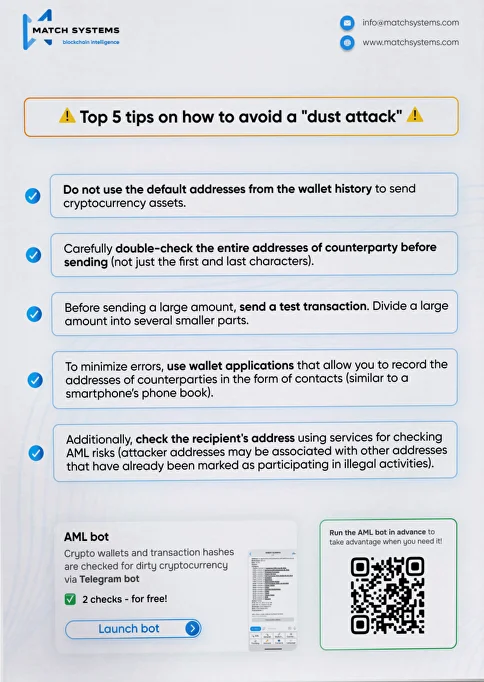
- Do not use the default addresses from the wallet history to send cryptocurrency assets.
- Carefully double-check the entire addresses of counterparty before sending (not just the first and last characters).
- Before sending a large amount, send a test transaction. Divide a large amount into several smaller parts.
- To minimize errors, use wallet applications that allow you to record the addresses of counterparties in the form of contacts (similar to a smartphone’s phone book).
- Additionally, check the recipient’s address using services for checking AML risks (attacker addresses may be associated with other addresses that have already been marked as participating in illegal activities).

Hot Stories
- Investigations Initia suffers $3.27M breach via compromised cloud credentials
- Investigations North Korea's TraitorTrader behind $6.3B Binance hack
- Investigations BitMart loses $391,000 amid staffing and security challenges
- Investigations zkLink suffers $783,000 loss due to cross-chain message exploit
- News FBI links Binance theft to North Korea
- News Chainalysis discloses access to customer data
- News Binance says it reserved $6.34B after the hack
- Investigations Chainalysis uses AI to track $387M stolen from Bitget
- News Binance reports $6.3B security incident
- Investigations Cysic Bridge Hacker Routed $744K to Tornado Cash After 10% Bounty