


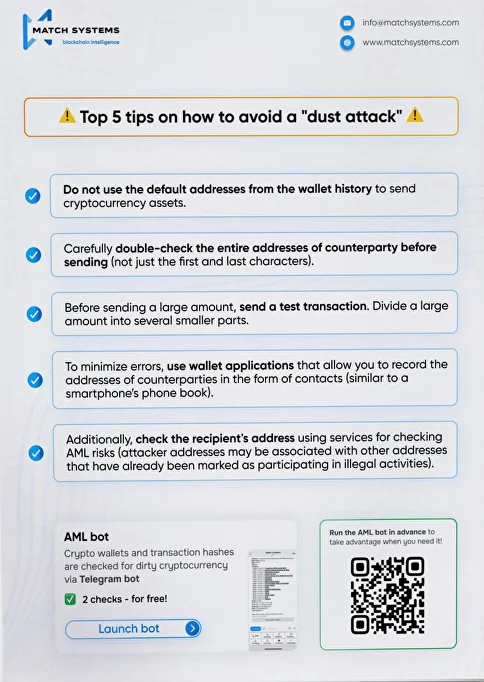
- Do not use the default addresses from the wallet history to send cryptocurrency assets.
- Carefully double-check the entire addresses of counterparty before sending (not just the first and last characters).
- Before sending a large amount, send a test transaction. Divide a large amount into several smaller parts.
- To minimize errors, use wallet applications that allow you to record the addresses of counterparties in the form of contacts (similar to a smartphone’s phone book).
- Additionally, check the recipient’s address using services for checking AML risks (attacker addresses may be associated with other addresses that have already been marked as participating in illegal activities).

Hot Stories
- Investigations CryptoBilis Hardware Wallet Theft Estimated at $93M to $94.5M
- Investigations Virginia man forfeits $101M in bitcoin after 40-year sentence
- Articles Crypto Stolen? What to Do Next
- Investigations Zano halted 36.9M fake tokens via chain rollback after exploit
- Fraud Schemes Third-Party Adapter Breach Drains $305K from Safe Wallets
- Investigations OFAC sanctions 10 for $40M ATM jackpotting using crypto
- Fraud Schemes Fake GIWA bridge steals $2M in Ether from DYORSWAP users
- Articles How Open-Weight AI Helps Hackers Find Code Vulnerabilities
- Investigations iOS app FomoPeek stole $579K in USDT via kernel exploits
- News Bitget confirms $351.6 million hack