



In August 2022, the U.S. Office of Foreign Assets Control (OFAC) did something without precedent: it sanctioned software. Not a person, not a company — a set of autonomous, un-ownable smart contracts called Tornado Cash. In March 2025 those same contracts were quietly delisted. That closed window — exactly 957 days, 6.79 million Ethereum blocks, 1.07 billion transactions — is the first complete, immutable record of what happens when a state tries to sanction a piece of permissionless code.
A team from the University of Birmingham and the University of Sydney (Liu, Ryan, Zhou & Berrang) measured that window end to end and published the results as “Evasion Under Blockchain Sanctions” (arXiv:2507.11721). Their finding is a paradox every compliance team should sit with: the sanctions worked and failed at the same time. Ordinary usage of Tornado Cash collapsed by more than 70%. The criminals the sanctions were meant to stop barely broke stride — they laundered through the very same contracts in 78% of major Ethereum hacks that followed. This article walks through the study in full: the method, the maths, the on-chain evidence, and what it means for anyone who screens crypto for a living.
What OFAC actually put on the list
The designation covered 170 Ethereum addresses that, at the moment of sanctioning, collectively held 499,769 ETH — roughly $983 million. Tornado Cash was the centre of gravity: it made up 44% of that initial balance and, by the end of the observation period, 99% of whatever remained. Strip out Tornado Cash and the rest of the OFAC crypto list is a rounding error. By March 2025 the sanctioned set had bled down to 145,579 ETH (about $286 million) as funds moved to fresh addresses and through obfuscation.
The reason this is hard is structural. Tornado Cash is not a wallet anyone can freeze. It is a set of fixed-denomination mixing pools — you deposit 0.1, 1, 10 or 100 ETH and later withdraw the same denomination to a fresh address, with a zero-knowledge proof standing in for any link between deposit and withdrawal. There is no operator to subpoena and no vault to seize. In total, Tornado Cash has been used to launder over $7 billion, including more than $455 million stolen by North Korea’s Lazarus Group. Sanctioning it was less like freezing a bank account and more like declaring a stretch of public road illegal to drive on — and hoping the traffic stops.
The core idea: from a blacklist to an impurity score
The study’s central methodological contribution is to abandon the yes/no blacklist and replace it with a continuous measure of how “dirty” an address is. They define an impurity — the portion of an address’s balance that can be traced back to a sanctioned source — and from it an impurity score between 0 and 1:
φ(s, addr) = ℐ(s, addr)ℋ(s, addr)Here ℋ is the address balance and ℐ the tainted portion of it. A score of φ = 0 means no traceable link to sanctioned funds; φ = 1 means the entire balance traces back to them. The elegance is that this maps directly onto how account-based blockchains already work — impurity is treated as just another property of an address’s state, updated block by block. When funds leave an address, its impurity is reduced proportionally; when they arrive, the recipient inherits a proportional share:
ℐ(si+1, addrto) = ℐ(si, addrto) + ⌈ arecv · ℐ(si, addrfrom)ℋ(si, addrfrom) ⌉Because the update is incremental — it piggybacks on Ethereum’s state-transition function as each block is processed — it runs in real time. On commodity hardware the algorithm updates each new block in 0.07 ± 0.03 seconds and sustains more than 1,500 transactions per second, comfortably ahead of Ethereum’s own throughput. That speed is what turns a forensic curiosity into something a compliance desk could actually run live.
The paradox in one chart: usage cratered, crime didn’t
The headline numbers look like a clean win. Comparing the 957 days after the sanction with an equally long stretch before it, every metric fell sharply.
| Metric | Action | Pre-sanction | Post-sanction | Change |
|---|---|---|---|---|
| Transactions | Deposit | 150,403 | 42,753 | −71.57% |
| Transactions | Withdraw | 139,404 | 44,283 | −68.23% |
| Unique addresses | Deposit | 39,397 | 9,175 | −76.71% |
| Unique addresses | Withdraw | 58,567 | 20,734 | −64.60% |
| Volume (ETH) | Deposit | 3.49M | 1.01M | −71.03% |
| Volume (ETH) | Withdraw | 3.27M | 1.08M | −66.80% |
On the day of the designation there was a visible stampede for the exit — the single largest day of withdrawals in the tool’s history, as ordinary users pulled their funds amid the uncertainty (the “P” spike below).
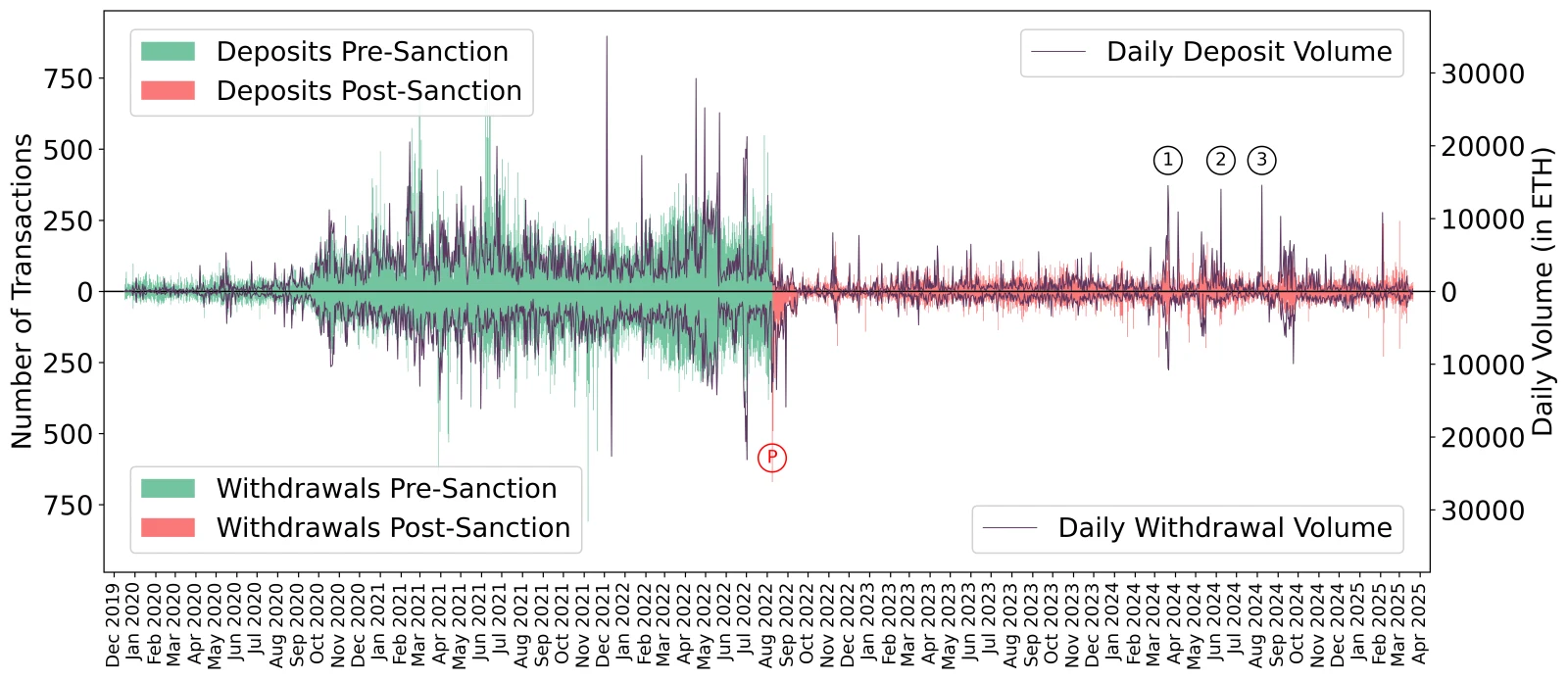
Now look at the right-hand side, after the collapse. Activity never reaches zero, and the sharpest post-sanction spikes are not noise — each is a single actor. Peak ① is the Heco Bridge exploiter depositing 11,200 ETH in a day (77% of that day’s volume). Peak ② is the Orbit Bridge exploiter with 12,930 ETH (92%). Peak ③ is the Nomad Bridge exploiter, whose 14,509 ETH made up 99.5% of the day’s total. The mixer emptied out of legitimate users and refilled with stolen money.
Cross-referencing a database of major DeFi exploits (losses over $100k) makes the point quantitatively. Of 60 post-sanction incidents involving active laundering, attackers routed funds through Tornado Cash in 47 — 78.33%. In roughly half of all malicious incidents the attacker also sourced initial funding from Tornado Cash, and in 83% of those cases the proceeds went straight back in. For the actors the sanction targeted, being on the OFAC list changed almost nothing.
Three structural reasons a smart-contract sanction leaks
The study’s real value is diagnostic. It isolates three structural reasons enforcement failed, and each is a lesson that reaches far beyond one mixer.
1. A blacklist is binary; laundering is analog
The OFAC model is a yes/no list: an address is sanctioned or it is not. That binary is trivially weaponised through dusting — sending tiny amounts of tainted ETH to addresses you don’t control, so automated screening flags innocent people. Within 48 hours of the designation, someone withdrew just 12 ETH from the smallest Tornado Cash pool and sprayed it across wallets that collectively held over 9 million ETH — an amplification factor above 750,000×. Targets included the Ethereum Foundation and major exchanges. The immediate result was a denial-of-service on compliance tooling: front-ends like Aave’s, using naive blacklist matching, began blocking blameless users.
The authors formalise why any binary scheme must fail here. A useful classifier needs a propagation rule — taint must spread from sanctioned addresses to those they pay. But once such a rule exists, strategic dusting can push the tainted set toward the entire chain:
lims→∞ | G(s) || ADDR | → 1When almost every address is “tainted,” the label is meaningless, and a compliant service is left with an impossible choice: block everyone (self-inflicted outage) or ignore the list (pointless). A continuous score dissolves the problem. An address that receives 0.001 ETH of dust against a 9,000 ETH balance scores essentially zero; an address that is 95% mixer output scores near one. The paper also shows why the obvious patches — time-based, hop-based, value-threshold or percentage-threshold rules — each have a clean evasion or a clean dusting attack. Only a balance-weighted, continuous metric resists both.
2. Block-level censorship is partial — and only skin deep
In theory, Ethereum block producers can refuse to include transactions that touch sanctioned addresses. In practice, only a minority do, and those that do only look one hop deep. Across the 6.79 million blocks studied, just 19% were built by producers that actively enforced OFAC — and even the strict ones filtered only direct deposits and withdrawals.
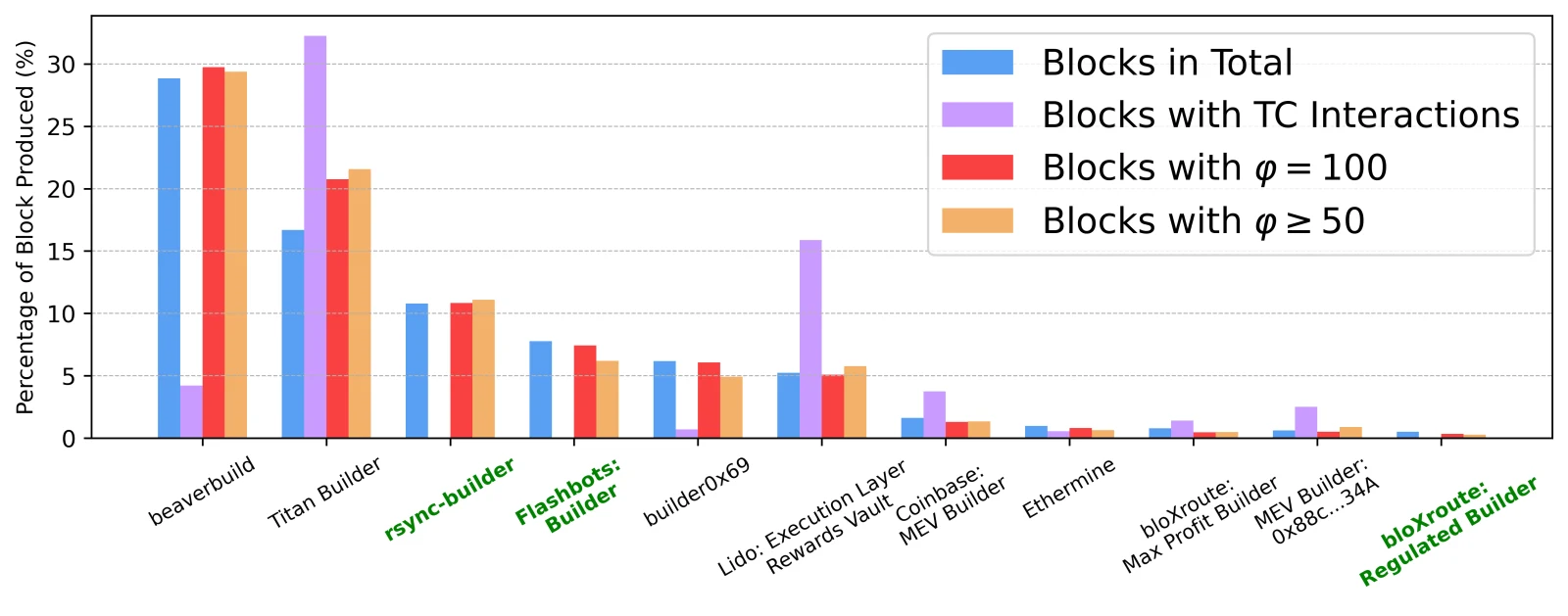
The clearest case is rsync-builder, which produced 734,343 blocks (10.81% of the sample) without a single direct Tornado Cash interaction — textbook compliance. But when the researchers looked at blocks carrying transactions from addresses that were 100% tainted mixer output, rsync-builder included those at 10.83% — essentially its overall production rate. Same story for Flashbots and bloXroute’s regulated builder. They rigorously block the deposit itself and then wave through every downstream transaction moving the same money. More than a million ETH flowed through the sanctioned mixer while this “enforcement” was nominally in effect. Some of it even funded MEV bots that pay builders for transaction ordering — meaning compliant builders were indirectly paid with mixer proceeds.
3. The exit is an entire ecosystem, not a door
Once value leaves the mixer it disperses across the whole of DeFi. The researchers mapped where. Analysing roughly 67.94 million addresses that could hold Tornado Cash–derived funds, they found contamination is broad but shallow — and concentration is what matters.
| Impurity score φ | # Addresses | Impurity amount ℐ | Balance ℋ |
|---|---|---|---|
| 0% – 5% | 67,321,336 (99.08%) | 877,243 ETH (76.05%) | 127.7M ETH (99.62%) |
| 5% – 50% | 560,858 (0.83%) | 19,364 ETH (1.68%) | 224,988 ETH (0.18%) |
| 50% – 95% | 16,665 (0.02%) | 4,155 ETH (0.36%) | 5,833 ETH (0.00%) |
| 95% – 100% | 45,258 (0.07%) | 252,764 ETH (21.91%) | 252,813 ETH (0.20%) |
The takeaway from that table: 99% of exposed addresses carry a trivial taint (under 5%) — overwhelmingly exchange hot wallets that mix everyone’s funds. But a tiny sliver — the 0.07% scoring above 95% — holds almost 22% of all tainted value. A binary list drowns you in the first group; an impurity score lets you go straight to the second.
Where does the money go? Decentralised exchanges absorbed roughly 27% of tainted volume, dominated by Uniswap (33%) and 1inch (26%). Both publish sanction-compliance policies and filter their web front-ends — but direct on-chain contract calls sail straight past those filters, and over 86% of that flow was converted into stablecoins and wrapped tokens for fungibility.
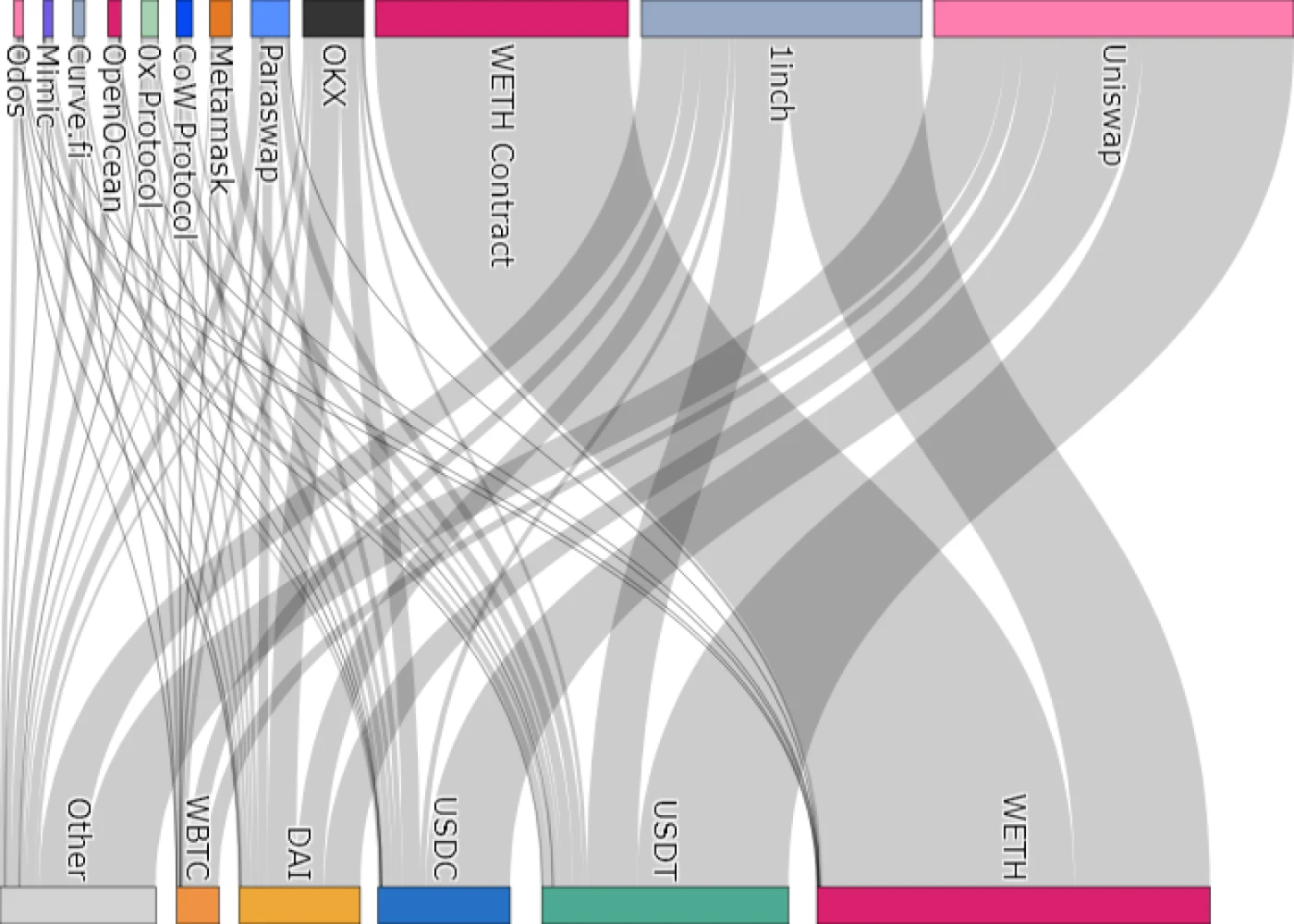
The most damning detail concerns stablecoins. USDT and USDC are issued by U.S. companies and both contain on-chain blacklist functions that can freeze tainted holdings. Over the entire period, across all the mixer-derived stablecoin flow tracked, exactly 40 addresses holding tainted USDT and 2 holding tainted USDC were ever frozen. Launderers treated freezable and non-freezable tokens no differently — because they correctly assumed the freeze button would almost never be pressed. The capability existed; the enforcement did not.
Another 32% of tainted volume left Ethereum entirely through cross-chain bridges. Here tracing gets genuinely hard: 20-plus bridges encode destination chains and recipients in inconsistent, non-standard metadata (the same chain is even labelled differently by different bridges), so the team had to build custom parsers for each.
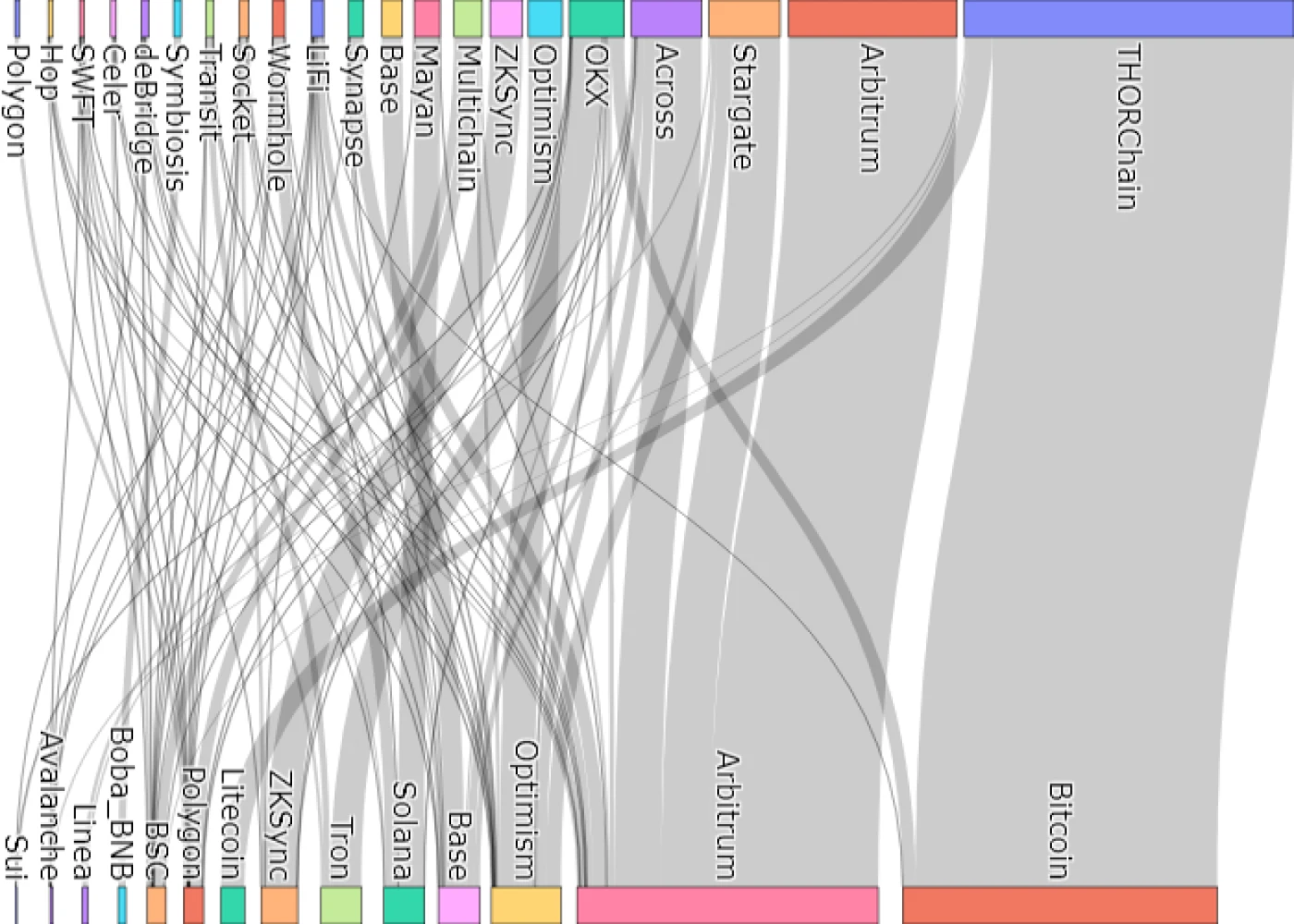
Bitcoin was the top single destination (33% of bridged volume, 96% of it via THORChain); more than half went to EVM chains and Layer-2 rollups. The motives are practical: rollback tolerance (bridging out reduces the chance of an Ethereum-side reversal), heightened obfuscation (each hop and each privacy tool multiplies the tracing difficulty — chaining Ethereum → Bitcoin CoinJoin → back to Ethereum → Tornado Cash raises end-to-end tracing cost exponentially), and simply lower fees and faster finality on L2s.
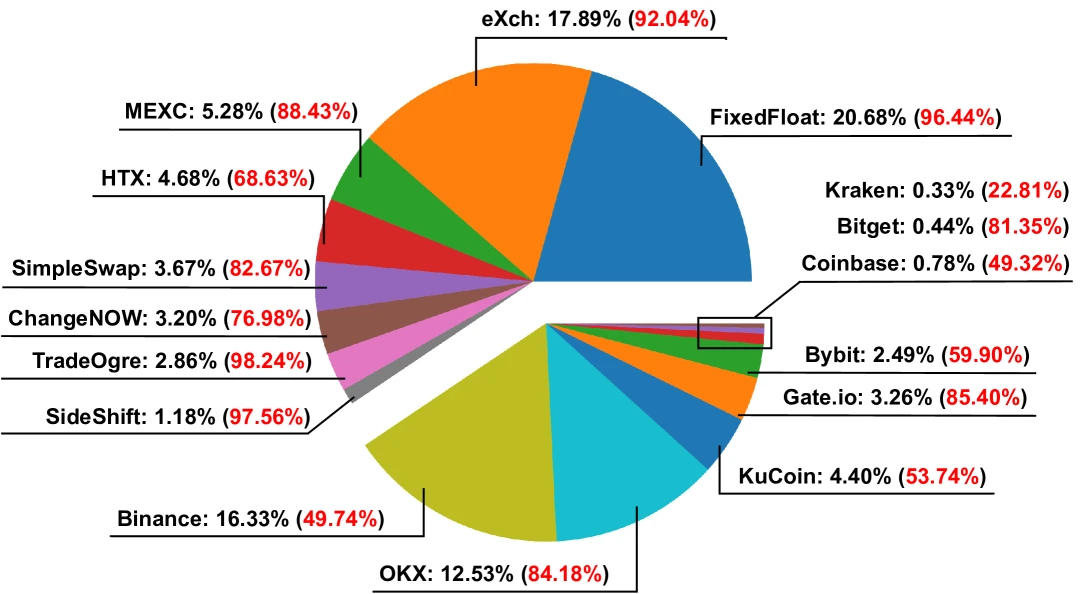
Centralised exchanges took about 10% of tainted flow. Splitting 16 CEXs into KYC and non-KYC groups exposed a clear signal: non-KYC platforms (FixedFloat, eXch, ChangeNOW and similar) not only saw large tainted volumes but received deposits with markedly higher impurity scores — because weak identity checks lower the odds of a freeze. U.S.-regulated venues like Coinbase and Kraken showed the lowest impurity, consistent with stricter screening under the sanction.
How the money actually moves
Because the study reconstructs fund flows rather than just counting volume, it surfaces the behavioural fingerprints of laundering — the patterns a good investigator learns to recognise.
The first is split-and-merge: funds fan out from one address into many (motif 021D), hop through single-use intermediaries (021C), then converge again (021U). It is designed to defeat monitoring that assumes a limited number of hops or a short laundering window. When the authors compared the transaction motifs of Tornado Cash withdrawers with those of the Bybit exploiter — the largest crypto theft on record — the fingerprints matched.

The second is test-depositing: before moving real size, the launderer sends a token amount — say 0.1 ETH — to an exchange to see whether the account is flagged or the funds frozen. If nothing happens, larger transfers follow. The researchers found this probing in a striking share of users at enforcement-heavy venues: 39% at Binance, 49% at OKX, 48% at Gate.io, 47% at KuCoin, 75% at Railgun. At platforms with no enforcement, users skipped the test and moved size in one shot. The caution itself is a detection signal — it reveals which venues the launderer believes are watching.
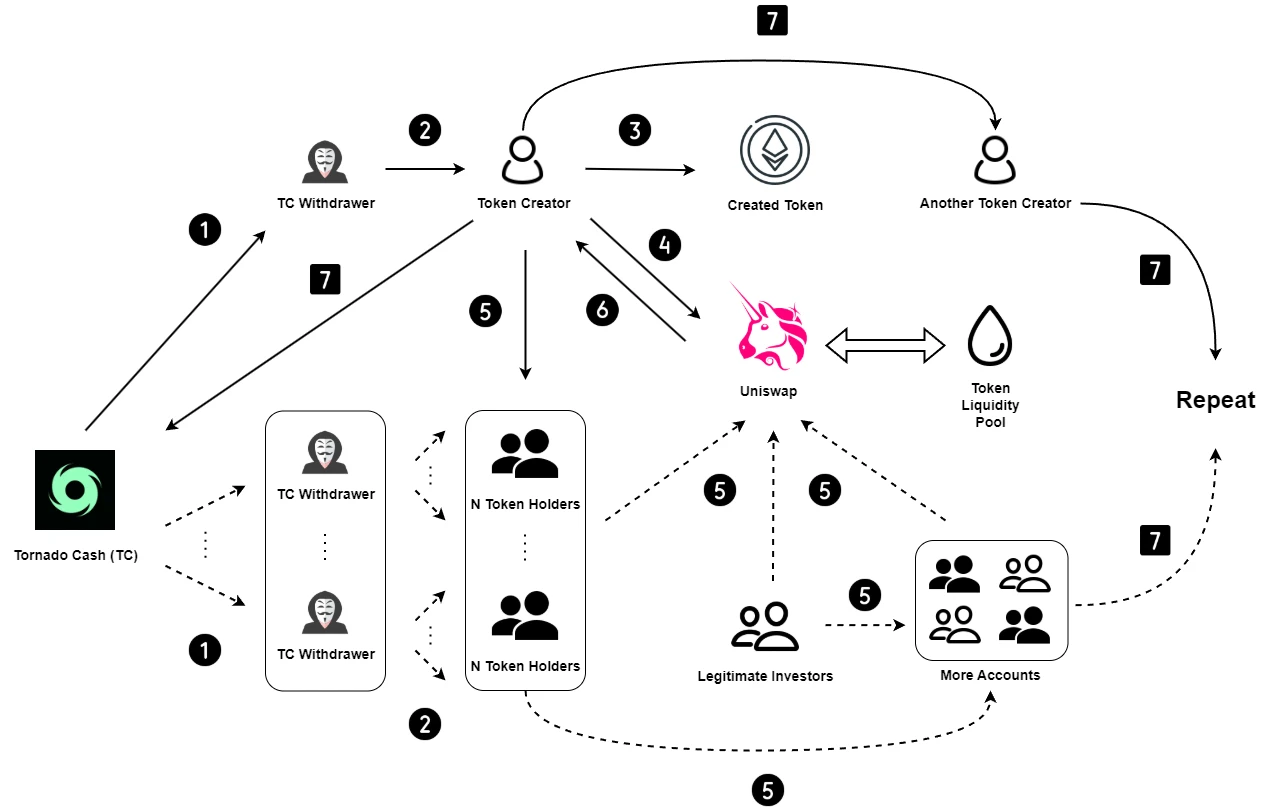
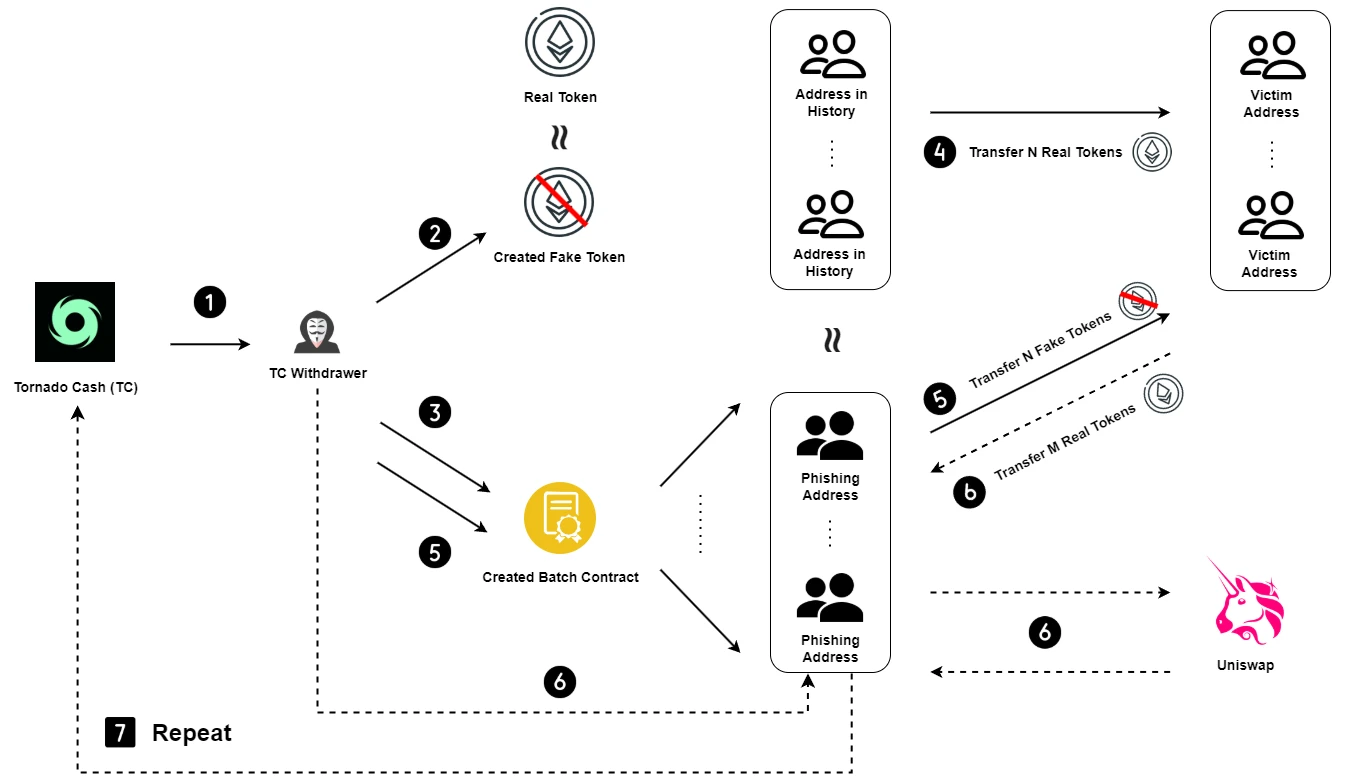
The same tainted liquidity also powers token scams. The paper documents two full workflows built on Tornado Cash withdrawals: rug pulls (deploy an ERC-20, seed a Uniswap pool, attract buyers, then yank the liquidity — which conveniently also launders funds by aggregating them into one address) and address-poisoning phishing (deploy look-alike tokens and spoofed transactions so a victim copies a malicious address from their history).
Does the tracking actually work? The Bybit test
A tracking method is only as good as its accuracy, so the authors validated theirs against the February 2025 Bybit exploit — using a proxy ground truth of 12,394 attacker-linked addresses published by Etherscan and Elliptic. Rendered by their own tool, the exploit’s transaction graph is the dense red weave on this article’s cover: not artistic chaos, but thousands of deliberate transfers engineered to exhaust an analyst’s patience.
| Ground truth | True positives | False pos. / False neg. | Precision | Recall |
|---|---|---|---|---|
| 12,210 addresses | 9,045 | 221 / 3,165 | 97.61% | 74.08% |
At a conservative 5% threshold the method reached 97.61% precision and 74.08% recall. And the “false positives” were instructive: of 221, some 118 were legitimate service contracts the attacker used, and the remaining 103 were new attacker addresses missing from the public datasets — confirmed by hand. In other words, once corrected, effective precision approaches 100%, and the tool surfaced attacker addresses the commercial blocklists had missed.
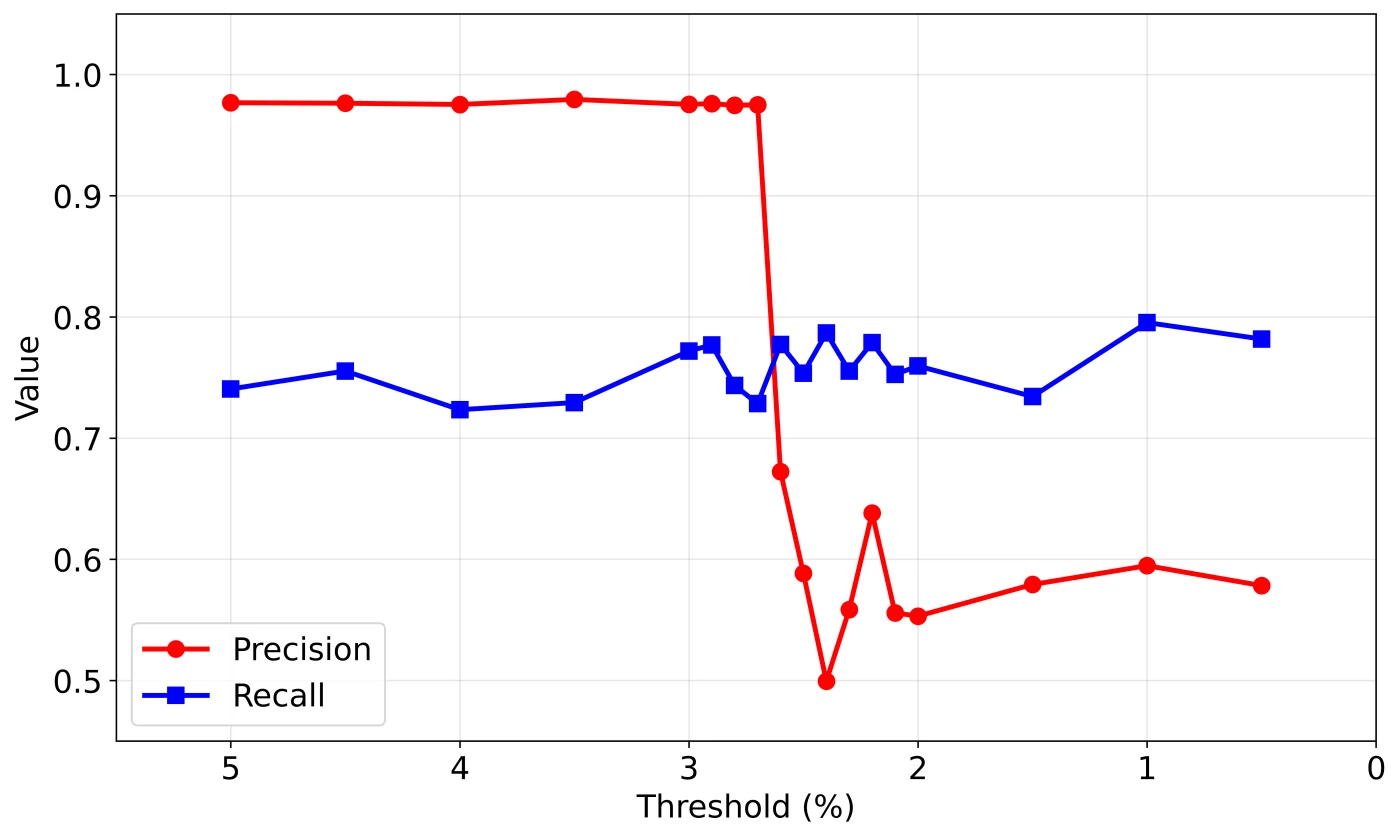
The authors are candid about limits. Recall of 74% reflects a deliberately conservative threshold and a focus on native ETH rather than ERC-20 tokens — which leaves a gap for “balance-manipulation” evasion, where an actor briefly swaps tainted ETH into tokens through a liquidity pool and back to dilute the score. Cross-chain coverage depends on hand-written parsers that need maintenance as bridges evolve. None of this undermines the central result; it maps the frontier for the next iteration.
What this means for compliance and investigations teams
Strip away the academic framing and the study reads like a field manual for where screening breaks. Four takeaways are worth carrying into practice.
- Replace binary blacklists with graded risk. A wallet is not “clean” or “dirty.” A continuous, balance-weighted taint score resists the dusting attacks that break a match-list, and it lets you set proportionate thresholds instead of freezing everyone a duster decides to poison.
- Screen the second hop, not just the first. Blocking a direct deposit to a sanctioned contract is table stakes and, on its own, close to theatre. The laundering happens in what comes after the mixer — the swaps, the bridges, the stablecoin conversions. Monitoring that stops at direct interactions guards the front door and ignores the hallway.
- Treat cross-chain as in-scope. A third of tainted flow left Ethereum. Any program that cannot follow value across bridges — parsing each bridge’s idiosyncratic metadata to recover the destination chain and address — has a blind spot exactly where sophisticated actors aim.
- Behaviour is evidence. Test deposits, split-and-merge motifs, sudden single-actor spikes into a “dead” mixer — these are recognisable, quantifiable patterns, not hunches. Built into monitoring, they turn a reactive freeze list into proactive detection.
The larger lesson is sobering but useful: sanctioning a smart contract can suppress casual use without meaningfully deterring the determined actors it targets — unless enforcement extends downstream and adopts quantitative, traceability-based risk rather than a name list. That is exactly the terrain on-chain forensics is built for: scoring exposure, following funds across services and chains, and reconstructing the flows a blacklist misses.
Match Systems works this problem for exchanges, funds and victims of theft every day. If your team is dealing with an active incident or needs to trace where funds have gone, you can submit a case to Match Systems.
Source: Endong Liu, Mark Ryan, Liyi Zhou, Pascal Berrang. “Evasion Under Blockchain Sanctions” (arXiv:2507.11721). Figures and data reproduced from the paper for commentary and analysis.
Hot Stories
- Investigations Initia suffers $3.27M breach via compromised cloud credentials
- Investigations North Korea's TraitorTrader behind $6.3B Binance hack
- Investigations BitMart loses $391,000 amid staffing and security challenges
- Investigations zkLink suffers $783,000 loss due to cross-chain message exploit
- News FBI links Binance theft to North Korea
- News Chainalysis discloses access to customer data
- News Binance says it reserved $6.34B after the hack
- Investigations Chainalysis uses AI to track $387M stolen from Bitget
- News Binance reports $6.3B security incident
- Investigations Cysic Bridge Hacker Routed $744K to Tornado Cash After 10% Bounty